What Britain’s Old Buildings Are Being Turned Into
Britain’s former pubs, banks, churches and post offices are being given new purposes, with hundreds of old buildings now being converted into homes, businesses and community spaces.
Buildings that no longer suit their original purpose are increasingly being adapted for modern uses, while owners of older or unusual properties may explore different selling options. Some choose to sell to cash house buyers rather than renovate an older or unusual property before moving.
Our analysis of more than 800 approved planning applications reveals how former pubs, banks, churches, chapels and post offices are being transformed across Britain, uncovering which buildings are most often repurposed and what they are becoming.
Note: This is an analysis of planning applications indexed by PlanIt that matched the selected building-type search terms. It isn’t a complete audit of every building conversion in Britain, and planning approval doesn’t confirm that the proposed work was completed.
Key findings
- Former pubs and public houses are the most commonly repurposed building type, accounting for 276 of 810 planning applications approved or conditionally approved since 2021.
- Banks are close behind, with 242 out of 810 applications for conversion, redevelopment or change of use.
- Two-thirds of all approved applications included residential use.
- Former pubs are most likely to become homes, with 198 applications including residential use.
- Applications for former churches increased by 90.9% between 2021 and 2025, showing growing interest in adapting historic buildings.
Which old British buildings are being converted most often?
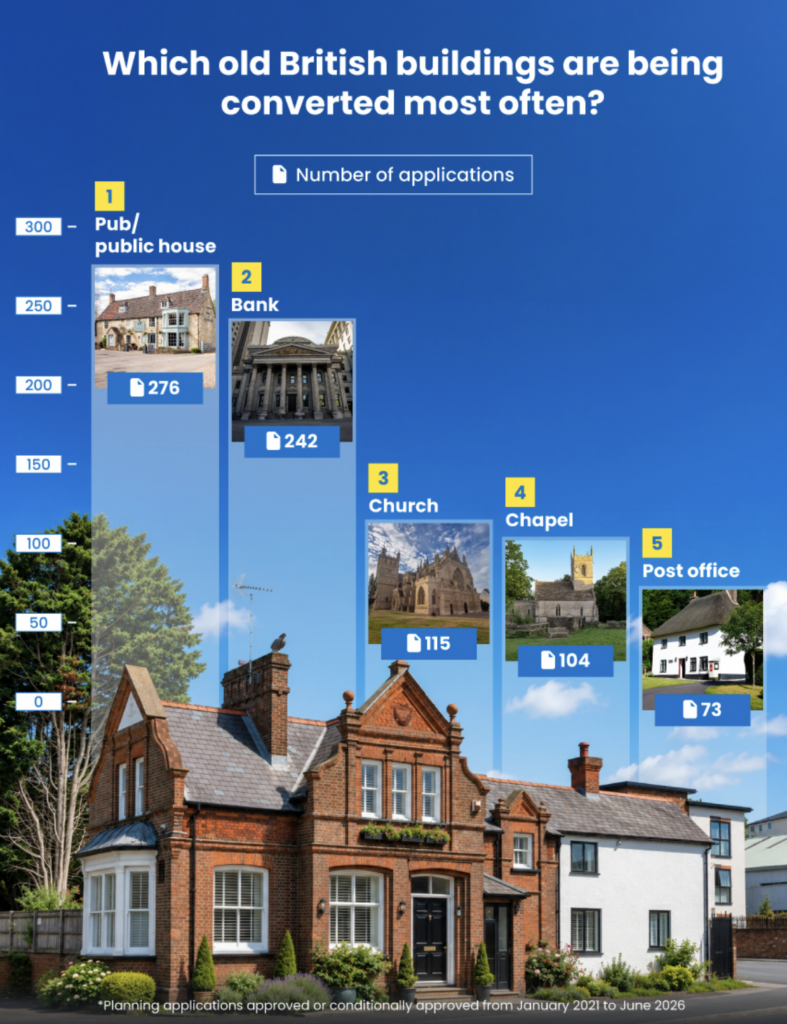
Some buildings are more likely than others to be adapted for new purposes. Former pubs and banks dominate the data, reflecting the changing role of traditional high street spaces and community buildings.
| Rank | Original building type | Number of applications |
| 1 | Pub/public house | 276 |
| 2 | Bank | 242 |
| 3 | Church | 115 |
| 4 | Chapel | 104 |
| 5 | Post office | 73 |
Former pubs are Britain’s most repurposed buildings
Former pubs and public houses account for the highest number of approved or conditionally approved applications in the analysis, with 276 identified since 2021.
Many traditional pubs have faced increasing financial pressures over the past decade, leaving more buildings available for redevelopment or alternative uses. As a result, some former pubs are being adapted rather than left unused.
Of the former pub applications analysed, 198 included residential use. This makes homes the most common new purpose for former pubs, although some have also been converted into retail spaces, hospitality venues, offices and other uses.
For communities, the conversion of former pubs can be a complicated issue. While repurposing can prevent buildings from falling into disrepair, the loss of local venues can also alter an area’s character.
Banks are finding new commercial and residential uses
Former banks were the second most commonly repurposed building type, with 242 applications identified.
The changing banking landscape has transformed town centres. More than 6,700 bank and building society branches have closed across the UK since 2015, leaving many prominent high street buildings available for redevelopment.
Unlike former pubs, banks were more likely to be converted into retail or commercial spaces. Our analysis found:
- 136 applications included retail or commercial use
- 119 applications included residential use
- 71 applications included hospitality or food and drink use
The size and location of many former bank buildings make them suitable for a range of uses, from shops and restaurants to offices and apartments.
Churches and chapels are being adapted for modern needs
Historic religious buildings are also being repurposed, with 115 former church applications and 104 former chapel applications identified.
These buildings often have unique architecture, large internal spaces and central locations, which can make them suitable for a wider range of uses. However, their redevelopment can require careful planning due to their heritage and community importance.
Residential use appeared most frequently among former churches and chapels in the analysed applications:
- 86 former church applications included residential use
- 87 former chapel applications included residential use
Other conversions included community spaces, hospitality venues, accommodation and transport-related uses.
Post offices are becoming less common, but still changing purpose
Former post offices had the lowest number of identified applications, with 73 recorded since 2021.
Almost 50 of these applications included residential use, making homes the most common new purpose. Other conversions included retail, hospitality, offices and storage.
As shopping habits and local services continue to evolve, smaller community buildings such as post offices may increasingly need to adapt to stay useful.
Why are more old buildings being converted?
The repurposing of older buildings demonstrates wider changes across the property market.
Some buildings no longer match how people use local areas. High streets have fewer traditional retailers, offices are adapting to hybrid working patterns, and community spaces are changing as local needs evolve.
Conversion can help bring unused or underused buildings back into active use. For homeowners, it also highlights how property demand is shifting towards flexible spaces that can support modern lifestyles.
Jack Malnick, at Sell House Fast, comments:
“Buildings often reflect the needs of the communities around them, and those needs naturally change over time. The rise in conversions shows that many older properties still have significant potential when their original purpose has changed.
“Former pubs, banks and community buildings often have strong locations and distinctive features, which can make them attractive for a range of new uses. The challenge is finding a balance between preserving what makes these buildings valuable while adapting them for the future.”
What are Britain’s old buildings being turned into?
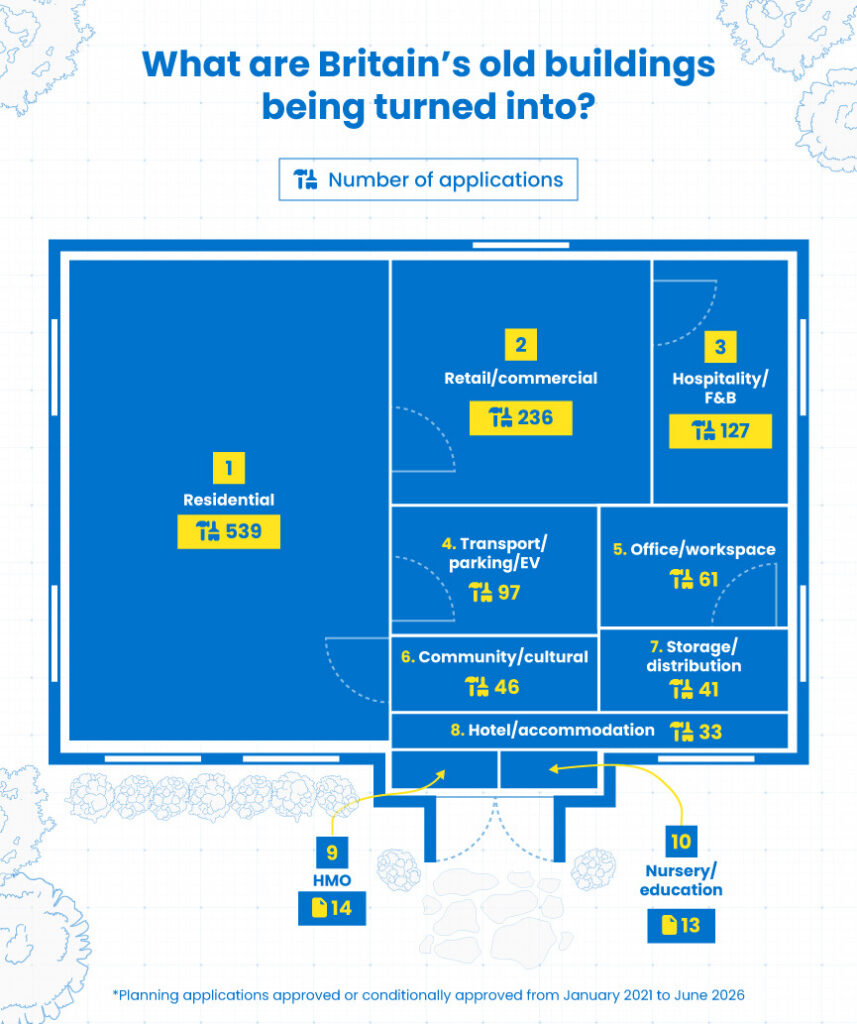
Residential use appears most frequently across the analysed applications, although some applications included multiple proposed uses.
Across all building types analysed, residential conversions appeared in 539 approved or conditionally approved planning applications, making it the most common new use identified.
However, old buildings are not only becoming homes. Many are being transformed into commercial spaces, hospitality venues, offices and community facilities, showing how flexible these properties can be.
| Rank | New use | Number of applications |
| 1 | Residential | 539 |
| 2 | Retail/commercial | 236 |
| 3 | Hospitality/F&B | 127 |
| 4 | Transport/parking/EV | 97 |
| 5 | Office/workspace | 61 |
| 6 | Community/cultural | 46 |
| 7 | Storage/distribution | 41 |
| 8 | Hotel/accommodation | 33 |
| 9 | HMO | 14 |
| 10 | Nursery/education | 13 |
*Some applications included multiple proposed uses, meaning categories are not mutually exclusive.
Residential conversions are driving Britain’s building changes
Homes are the most common destination for Britain’s former buildings, appearing in more than twice as many applications as the next most common category.
Residential use was identified in around two-thirds of all approved applications analysed, making housing by far the most common destination for former community and commercial buildings.
Former pubs are particularly likely to become homes, with 198 applications including residential use. Churches and chapels also frequently move towards residential conversion, with 86 and 87 applications respectively.
For property owners, converting an existing building can help preserve its structure while adapting it to modern demands. However, successful conversions often depend on factors such as location, planning permission, building condition, and whether the space meets current housing requirements.
Commercial spaces are an important part of the picture
While residential conversions dominate overall, many buildings are being retained for commercial purposes.
Retail and commercial uses appeared in 236 applications, making it the second-most-common category.
Former banks were the biggest contributors to this trend. Their central locations and larger floor plans often make them suitable for shops, offices and other commercial uses.
The data found:
- 136 former bank applications included retail or commercial use
- 55 former pub applications included retail or commercial use
- 22 former post office applications included retail or commercial use
The results show that residential conversion isn’t the only route being proposed for former high street buildings.
Hospitality is giving old buildings new life
Hospitality remained one of the most common alternative uses, suggesting that many prominent buildings continue to serve public-facing roles rather than being converted exclusively into housing.
Former banks, pubs and post offices were among the building types converted into restaurants, cafés, bars and other hospitality venues.
Former pubs accounted for 32 hospitality-related applications, showing that some buildings are being adapted to support new forms of social activity rather than being replaced entirely.
Offices and flexible workspaces are emerging uses
Office and workspace conversions appeared in 61 applications.
As working patterns continue to change, some buildings are being adapted into flexible spaces that support businesses, freelancers and local organisations.
Former banks were the most common source of office conversions, with 26 applications including this use. Their larger layouts and central locations can make them suitable for modern workspace requirements.
The future of Britain’s old buildings
Britain’s changing buildings are increasingly being adapted for different roles.
Former pubs are becoming homes, former banks are becoming commercial spaces and historic buildings are being given new roles within their communities.
Jack Malnick, at Sell House Fast, comments:
“Successful building conversions usually come down to understanding what people need from spaces today. Homes, workplaces, and community spaces are all evolving, and older buildings can often provide character and flexibility, giving converted buildings a distinctive identity.
“The strongest conversions are those that respect the building’s original features while creating something practical for modern use.
“As lifestyles and local economies continue to change, the ability to adapt existing buildings may become increasingly important. The next chapter for Britain’s high streets may not be about replacing old buildings, but finding new ways for them to remain useful.”
Where are Britain’s old buildings being repurposed most?
Building conversions are taking place across Britain, but some local authorities have seen considerably more approved or conditionally approved applications than others.
Cornwall recorded the highest number of applications in the dataset, while several other local authorities across England, Scotland and Wales also feature prominently. The spread of locations suggests that repurposing older buildings is not limited to major cities or one part of the country, but shows changing local needs across a wide range of communities.
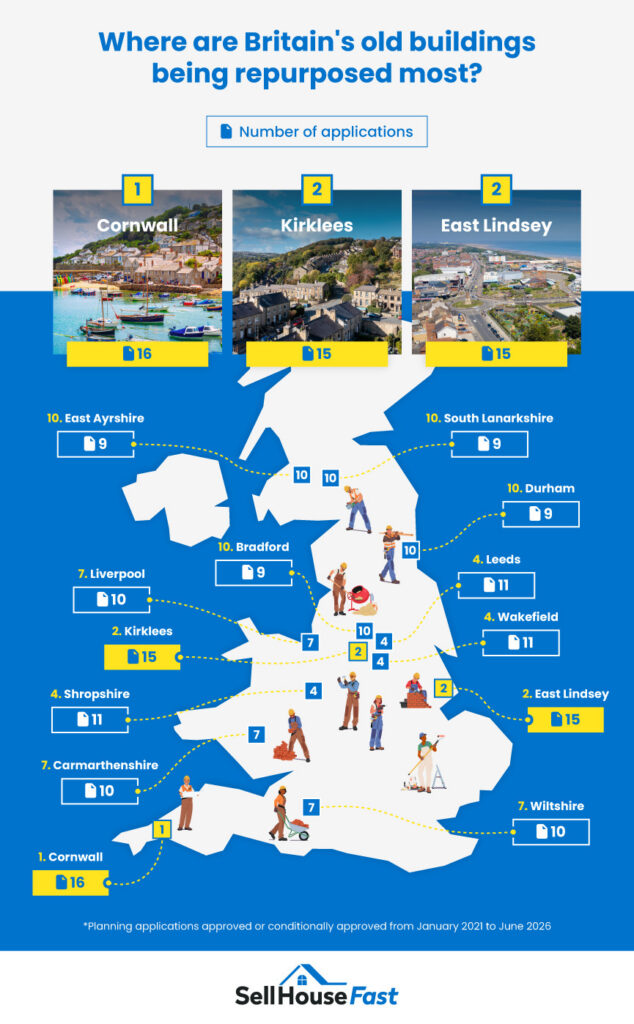
| Rank | Local authority | Number of applications |
| 1 | Cornwall | 16 |
| 2 | Kirklees | 15 |
| 2 | East Lindsey | 15 |
| 4 | Shropshire | 11 |
| 4 | Leeds | 11 |
| 4 | Wakefield | 11 |
| 7 | Wiltshire | 10 |
| 7 | Carmarthenshire | 10 |
| 7 | Liverpool | 10 |
| 10 | Bradford | 9 |
| 10 | South Lanarkshire | 9 |
| 10 | Durham | 9 |
| 10 | East Ayrshire | 9 |
Cornwall tops the rankings for approved conversion applications
Cornwall recorded 16 approved or conditionally approved planning applications involving former pubs, banks, churches, chapels and post offices, the highest total in the analysis.
Most applications included residential use, with 15 involving new homes. The county also saw applications covering retail, transport-related uses and storage, highlighting the range of ways older buildings are being adapted.
Applications covered every building type included in the research, making Cornwall the most diverse local authority within the dataset.
Kirklees and East Lindsey follow closely behind
Kirklees and East Lindsey each recorded 15 approved or conditionally approved applications.
Kirklees was heavily influenced by former pubs, which accounted for 10 applications. Residential use appeared most frequently, although applications also included retail, hospitality, transport and community uses.
East Lindsey presented a different picture. Nine of its identified applications involved former chapels, making religious buildings a significant part of the area’s conversion activity. Residential use again dominated, appearing in 12 applications.
The contrast between these two authorities demonstrates that building conversion trends often reflect the types of historic buildings found within each local area.
Different areas are repurposing different types of buildings
While pubs dominate nationally, local trends vary considerably. Wakefield recorded seven former bank applications, the highest among the leading authorities, suggesting changing high street banking continues to reshape some town centres.
East Lindsey saw more former chapel conversions than any other authority in the top rankings, while Cornwall recorded applications across every building type included in the research.
Rather than following a single national pattern, local authorities appear to be adapting buildings most closely linked to their own history and communities.
Jack Malnick, from Sell House Fast, comments:
“Every area has a different property landscape. Some communities have seen more bank closures, while others have larger numbers of historic pubs or religious buildings. What we’re seeing is that many of these properties are being adapted instead of standing empty, helping them remain part of the local community in a different way.”
Planning approvals have remained consistently high since 2022
The research also examined planning applications by recorded decision year to understand how conversion activity has changed over time.
Although annual totals fluctuate, approvals have remained relatively consistent since 2022, suggesting continued interest in repurposing older buildings.
| Decision year | Applications | Year-on-year change |
| 2021 | 114 | – |
| 2022 | 186 | +63.2% |
| 2023 | 133 | -28.5% |
| 2024 | 143 | +7.5% |
| 2025 | 152 | +6.3% |
| 2026 (year-to-date) | 59 | – |
The largest increase occurred between 2021 and 2022, when approved applications rose by 63.2%. While application numbers fell the following year, approvals increased again during both 2024 and 2025.
Because 2026 only includes part of the year, it cannot be compared directly with previous annual totals.
Churches have seen the fastest long-term growth
Looking at individual building types, former churches experienced the strongest growth across the study period.
| Building type | Change in approved applications (2021-2025) |
| Church | +90.9% |
| Chapel | +60.0% |
| Bank | +33.3% |
| Pub/public house | +20.9% |
| Post office | -8.3% |
Approved applications involving former churches almost doubled between 2021 and 2025.
Chapels also recorded strong growth, while applications involving former banks and pubs continued to increase more steadily.
Former post offices were the only building type to record a decline over the same period.
Although planning activity naturally varies from year to year, the figures suggest continued interest in finding new uses for older community buildings.
What do these changing buildings mean for homeowners?
Britain’s changing buildings indicate more than architectural trends. They show how communities, businesses and housing needs continue to evolve.
Many older buildings remain structurally sound and occupy central locations, making them suitable candidates for redevelopment when their original purpose is no longer viable. Rather than leaving these properties vacant, planning applications increasingly show them being adapted for homes, businesses and community uses.
Character buildings, former commercial premises and unusual homes can all appeal to the right buyer, but they may also require specialist knowledge, planning considerations or renovation work.
For vacant buildings or homes requiring significant updating, preparing a property for the open market may not always be the preferred option.
In those circumstances, selling to a cash house buyer can provide an alternative route. Rather than carrying out extensive improvements before marketing a property, homeowners can sell it in its current condition without waiting for a traditional property chain.
Jack Malnick, from Sell House Fast, comments:
“Every property has a different story. While some buyers are looking for fully modern homes, others see the opportunity in older buildings with character or redevelopment potential. The right selling route often depends on the property’s condition, the owner’s circumstances and how quickly they need to move.”
Methodology
Sell House Fast is a leading UK cash house buyer, helping homeowners achieve a guaranteed sale without the uncertainty or waiting times of the open market – completing sales in as little as seven days.
To identify Britain’s “buildings reborn”, we analysed Planit-indexed planning applications approved or conditionally approved from 1 January 2021 onwards.
The analysis focused on former pubs/public houses, banks, churches, chapels and post offices being proposed for conversion, redevelopment or change of use.
Applications were identified using keyword searches across PlanIt planning application descriptions, including:
- “former public house”
- “former pub”
- “former bank”
- “former church”
- “former chapel”
- “former post office”
The results were combined into one dataset and any duplicate records, secondary/admin applications and unclear matches were removed.
Each remaining application was reviewed and classified by:
- original building type
- proposed new use
- local authority
- application status
- application date
Only applications marked as permitted or conditionally approved were included in the final dataset.
Proposed new uses were grouped into broad categories, including residential, retail/commercial, hospitality/F&B, office/workspace, nursery/education, community/cultural, hotel/accommodation, storage/distribution, transport/parking/EV, leisure/gym, medical/dental, care/residential care and HMO.
As some applications involved mixed-use schemes, a single application could be counted under more than one proposed new-use category. For this reason, the new-use figures show the number of applications that included each use, rather than mutually exclusive totals.
Yearly trends were based on the decision year, using each application’s recorded decision date. Applications without a recorded decision date were excluded from the analysis by year.