Moving House Stress: The Biggest Costs, Regrets, and Moving Day Pressures
Moving home can be as stressful as going through a break-up or divorce, according to almost a quarter of survey respondents.
The pressure is not just emotional. Between unexpected costs, packing, removals, paperwork, timelines, and sale uncertainty, a move can quickly become harder to manage than many people expect.
To understand where the biggest pressure points lie, Sell House Fast surveyed 1,000 UK adults about the stress, costs, and regrets associated with moving home. We also analysed Google search data to reveal what movers are looking for when they need help, and estimated the practical costs that can catch households out before moving day.
| Selling your home and want more certainty?Moving stress does not always start with packing boxes. For many homeowners, the sale itself can be one of the biggest sources of uncertainty.Sell House Fast works with homeowners who want a faster, more certain route to sale. As cash house buyers, we offer a simpler process for sellers who value speed and certainty. |
Key findings
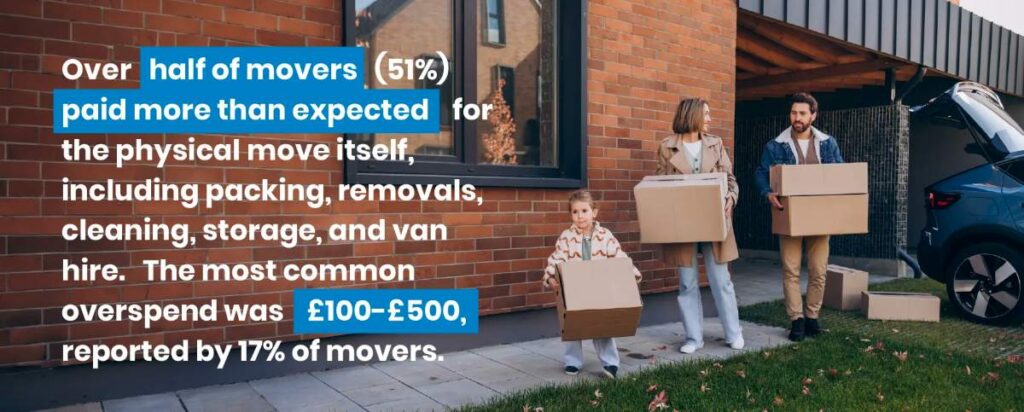
- Over half of movers (51%) paid more than expected for the physical move itself, including packing, removals, cleaning, storage, and van hire. The most common overspend was £100-£500, reported by 17% of movers.
- The practical cost of moving can reach almost £1,600 before legal fees are included, with an average cost of £1,590.45 across removals and packing, end-of-tenancy cleaning, storage, childcare, and time off work.
- Almost one in four movers (23%) said their biggest moving regret was linked to packing or decluttering, with 12% wishing they had started packing earlier and 11% wishing they had thrown more belongings away before moving day.
- Moving home is rated as stressful as going through a break-up or divorce, with 23% of respondents rating both life events as 10 out of 10 for stress.
- Women are more likely to find moving home extremely stressful, with 30% giving it a 10 out of 10 stress score, compared with 16% of men.
Unexpected moving costs leave over half of movers paying more than planned
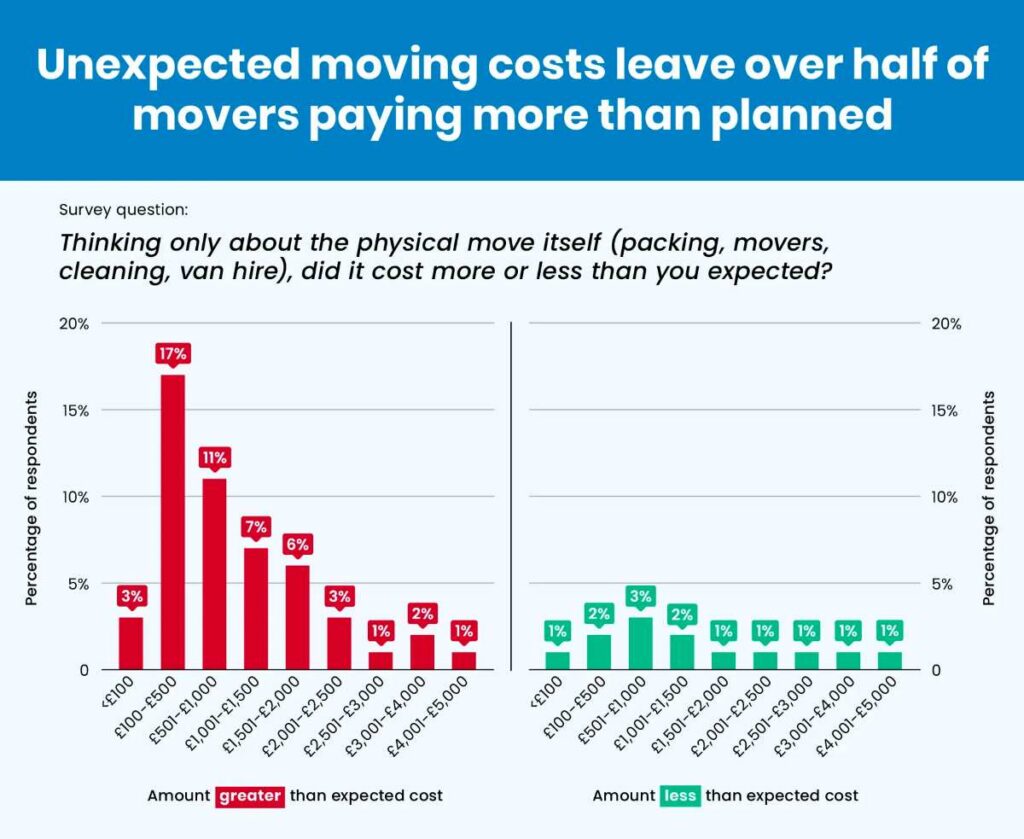
Percentages may not add up to 100 due to rounding
The physical cost of moving home is one of the easiest areas to underestimate. Even before legal fees, deposits, mortgage costs, or estate agent fees are considered, the practical side of moving can quickly become more expensive than expected.
According to the survey, over half (51%) of people who had moved home said the physical move itself cost more than they expected. This includes costs such as packing, removals, cleaning, storage, and van hire.
Only 26% said the cost was exactly what they expected, while 10% said there were no costs involved. This leaves a large share of movers facing extra costs at a point when many household budgets are already under pressure.
The most common overspend was between £100 and £500, reported by 17% of movers. However, a notable share faced much higher costs:
- 11% paid £501 to £1,000 more than expected
- 7% paid £1,001 to £1,500 more
- 6% paid £1,501 to £2,000 more
- 7% paid more than £2,000 extra
Under-45s are most likely to be caught off guard by higher costs
The survey suggests younger movers may be the least prepared for unexpected costs.
Among 35- to 44-year-olds, 61% said their move cost more than expected, the highest among all age groups. Younger movers were close behind, with 59% of 18- to 24-year-olds and 56% of 25- to 34-year-olds also saying their move cost more than they planned.
Older movers appear to have a more accurate view of the cost of the physical move. More than half of those aged 65 and over (52%) said the cost was exactly what they expected, compared with just 7% of 18- to 24-year-olds.
That gap may point to experience. Older homeowners are more likely to have moved before, planned around known costs, or taken a more cautious approach to budgeting. Younger movers may be dealing with these costs for the first time, making it easier for packing materials, cleaning, van hire, and removals to add up unnoticed.
Scotland and Northern Ireland see the highest share of movers paying more than expected
Regionally, movers in Scotland were among the most likely to face higher-than-expected costs. Almost two-thirds (64%) said the physical move cost more than planned.
Northern Ireland recorded an even higher share at 70%. Among those respondents, 40% said the move cost £501-£1,000 more than expected.
Across the rest of England and Wales, the share of movers paying more than expected was relatively consistent, averaging 51%.
Scotland also recorded one of the highest shares of larger overspends, with 10% saying their move cost £1,501-£2,000 more than expected, and 3% even underbudgeting by £4,001-£5,000.
The real cost of moving can reach almost £1,600 before legal fees are included
To show how quickly the practical costs of moving can add up, Sell House Fast also estimated the average cost of several commonly overlooked moving expenses.
Based on the analysis, the physical move itself can cost around £1,590.45 before wider costs such as legal fees, estate agent fees, surveys, mortgage fees, or stamp duty are included.
| Term | Average cost |
| Removals/packing | £1,000.00 |
| End of tenancy cleaning | £260.00 |
| Storage | £42.00 |
| Childcare | £144.77 |
| Time off work | £143.68 |
| Total | £1,590.45 |
Removals and packing make up the largest share of this total, at around £1,000. But the smaller costs are also important because they are often the easiest to miss when planning a move.
End-of-tenancy cleaning costs an average of £260, while childcare and time off work add another £288.45. These costs are not always included in the moving budget, but they can still affect how much money a household needs on hand around moving day.
If the physical move costs around £1,590.45, someone who paid £100 to £500 more than expected may have originally budgeted between £1,090.45 and £1,490.45.
For younger movers, the gap is a little more noticeable. Almost a quarter of 18- to 24-year-olds (24%) said their move cost £1,501 to £2,000 more than expected. Based on the average physical moving cost, this suggests some younger movers may have expected to spend little to nothing on the practical side of moving, only to face costs closer to £1,600 by moving day.
| Why moving costs become stressful when they appear too late
Jack Malnick, Founder and Managing Director at Sell House Fast, said: |
Packing, budgeting, and decluttering are the biggest moving regrets
Grouped together, the biggest regret areas for movers were:
- Packing and decluttering: Almost one in four movers (23%) said their biggest regret was either not packing earlier or not throwing more belongings away before moving day.
- Money planning: Nearly one in five (18%) said they wished they had either budgeted more accurately or researched costs better.
- Professional and practical support: More than a third of movers (35%) said their biggest regret related to the help or services they used, or did not use, during the move. This includes movers, solicitors, estate agents, vehicle hire, and help from friends or family.
Only 22% said they did not wish they had done anything differently, meaning more than three-quarters of movers had at least one thing they would change about their last move.
Younger movers are the least prepared for moving costs
Among 18- to 24-year-olds, the joint top regrets were not researching costs more thoroughly and the estate agent they used, both selected by 19% of respondents. This age group was also the most likely to say they wished they had chosen different movers (12%) and hired a more appropriate vehicle (10%).
The clearest age differences include:
- Cost research: Almost one in five 18- to 24-year-olds regretted not researching moving costs better, making them nearly five times more likely to say this than movers aged 65 and over.
- Estate agent choice: 18- to 24-year-olds were twice as likely as 54- to 64-year-olds to wish they had chosen a different estate agent.
- No regrets: Those aged 65 and over were more than five times as likely as 18- to 24-year-olds to say they had no moving regrets, at 39% compared with 7%.
Among 25- to 34-year-olds, the most common regret was not packing earlier, with 19% saying they wished they had started sooner to reduce moving stress. This was the highest share of any age group and suggests that packing can become a particular pressure point for movers balancing work, family, or first-time homeownership.
Decluttering becomes a bigger regret for older movers
While younger movers were more likely to regret cost research and service choices, older movers were more likely to wish they had reduced the amount they needed to move.
Among 45- to 54-year-olds, 17% said they wished they had thrown more belongings away, the highest share of any age group. This was followed by 14% of 55- to 64-year-olds and 14% of those aged 65 and over.
That matters because decluttering affects more than the number of boxes. More belongings can mean:
- More packing materials
- Longer loading times
- A larger vehicle
- Higher removal costs
- More decisions to make before moving day
- More to unpack once the move is complete
Homeowners who have lived in the same property for a long time can underestimate how easily decluttering becomes one of the biggest parts of moving. The issue is not just what needs to be packed, but how many decisions need to be made before anything can leave the house.
Manchester movers are the most likely to regret their estate agent choice
Manchester’s regrets look different from those of most other cities. Rather than packing or decluttering being the main issue, the estate agent choice stood out.
More than a quarter of Manchester movers (26%) said they wished they had used a different estate agent. This is more than three times the national average of 8%.
Manchester also had one of the lowest shares of movers saying they had no regrets, at just 9%. This suggests movers in the city were more likely to feel that at least one part of the process could have been handled differently.
Elsewhere, the main city-level pressure points were:
- Packing earlier: Bristol and Sheffield topped the list, with 21% of movers in each city wishing they had started packing sooner. Newcastle was close behind at 19%.
- Decluttering: Edinburgh had the highest regret rate, with 20% saying they should have thrown more belongings away before moving. Southampton ranked next at 18%.
- Budgeting: Belfast stood out for budgeting regrets, with 20% wishing they had planned costs more accurately. Sheffield also ranked highly at 18%.
- Researching costs: Manchester led the way in cost research regrets, with 16% saying they should have looked into costs more thoroughly. London followed at 13%.
- Hiring movers: Southampton was the city most likely to regret not hiring movers, at 12%. Norwich and Glasgow were also among the highest, at 11%.
Moving home is more stressful than becoming a parent
Moving home is often treated as a practical process, but the survey suggests it can carry the same emotional weight as some of life’s biggest changes. Nearly a quarter of movers (23%) rated moving home a 10 out of 10 for stress.
This means moving home was rated:
- The same as going through a break-up or divorce, which was also rated 10 out of 10 for stress by 23% of respondents
- More stressful than changing jobs, rated 10 out of 10 by 12% of respondents
- More stressful than becoming a parent, also rated 10 out of 10 by 12% of respondents
Nearly twice as many women as men found moving home extremely stressful
Women were generally more affected by the stress of moving home. Almost a third of women (30%) rated moving as 10 out of 10 for stress, compared with 16% of men. The average stress score was also higher among women, at 8.2 out of 10, compared with 7.8 among men.
Among all possible stressors, women were most overwhelmed by packing belongings (chosen by 30% of respondents), while men were split between that and legal/conveyancing delays (25%).
Wales records the highest average moving stress score
Regionally, Wales recorded the highest average moving stress score, at 8.3 out of 10. It also had the highest share of respondents rating moving home as 10 out of 10 for stress, at 34%.
The regional picture shows that moving home was rated as highly stressful across the UK:
- Wales: 8.3 average stress score
- South East England: 8.1
- South West England: 8.0
- Northern England: 7.9
- Northern Ireland: 7.9
- Central England: 7.8
- Scotland: 7.8
| Why moving home can feel harder than people expect
Jack Malnick said: |
Search data shows movers are looking for practical help, not just advice
| Rank | Category | Number of home-move searches | Percentage of total searches |
| 1 | Local removal services | 502,700 | 54% |
| 2 | Stress/overwhelm | 179,470 | 19% |
| 3 | Cost concerns | 135,550 | 14% |
| 4 | Packing help | 105,170 | 11% |
| 5 | Last-minute/urgency | 13,370 | 1% |
Search data shows that the pressure around moving home starts long before moving day. Across the terms analysed, there were more than 936,000 Google searches between April 2025 and March 2026 relating to moving costs, removals, packing, stress, checklists, and last-minute moving help.
Local removal services accounted for the largest share, with 502,700 searches, or 54% of the total. This includes searches such as:
- “Man with a van near me”: 173,400 searches
- “Removal companies near me”: 133,600 searches
- “House clearance near me”: 75,200 searches
- “House removals near me”: 48,400 searches
Terms related to stress or feeling overwhelmed generated almost one in five searches (179,470), led by “moving house checklist” (116,600).
That matters because the earlier survey findings show preparation is one of the biggest sources of regret. One in eight (12%) of movers wished they had started packing earlier, while 11% wished they had thrown more belongings away before moving day. The search data reflects the same issue: people know they need a plan, but may only look for one once the pressure has started to build.
Cost concerns also remain a clear theme, with 135,550 searches across the year. The highest-volume terms included:
- “Moving house costs”: 34,800 searches
- “How much does it cost to move house?”: 25,900 searches
- “Cost of removals”: 16,700 searches
- “Removal quotes”: 14,050 searches
- “Cheap removal companies”: 10,520 searches
Last-minute searches were smaller, at 13,370, but they still reveal where stress can peak. Searches such as “express removals” (3,740), “same day removals” (2,070), and “last minute movers” (1,000) suggest some movers are trying to solve major logistical problems at short notice.
| Why search demand shows the need for a clearer moving planJack Malnick said:
“Search behaviour shows that people are not only worried about moving home, but they are actively trying to make the process feel more manageable. The high number of searches for checklists, costs, packing help, and local removals suggests that many movers are looking for clearer guidance before making decisions.“The challenge is that people often search for these things once the pressure is already building. By that point, there may be less time to compare removal firms, reduce what needs to be moved, or plan around costs properly.“A good moving plan should bring all of this together early. That means understanding the likely costs, booking practical support in good time, starting the packing process sooner than feels necessary, and knowing what needs to happen in the final weeks before moving day.” |
Moving house checklist: what to do and when to reduce last-minute stress
With “moving house checklist” attracting 116,600 searches, it is clear that many movers want a simple plan to follow. This checklist is designed to help homeowners work backwards from moving day, covering what to organise at different stages.
Eight weeks before moving
- Confirm your moving date, if possible
- Get quotes for removals or van hire
- Start decluttering room by room
- Gather packing materials and boxes
- Create a moving budget, including a buffer for unexpected costs
Four weeks before moving
- Book your removals company or vehicle
- Start packing non-essential items
- Notify your utility providers, insurer, and broadband provider
- Arrange mail redirection
- Check arrangements with your solicitor or estate agent
Two weeks before moving
- Continue packing, leaving only essentials for daily use
- Label boxes clearly by room
- Arrange childcare or pet care for moving day, if needed
- Confirm timings with movers
- Make a list of jobs for moving day
One week before moving
- Pack an essentials box with key documents, chargers, toiletries, and basic kitchen items
- Defrost the freezer, if needed
- Confirm key collection and handover arrangements
- Finish most of the packing
Moving day
- Keep important documents and valuables with you
- Do a final walk-through before leaving
- Check cupboards, loft space, sheds, and storage areas
- Take meter readings
- Make sure keys are handed over as agreed
Reducing moving stress starts with knowing your options
With the survey showing that moving costs, preparation, and uncertainty are all major sources of stress, Jack Malnick explains why knowing your options early can make a move easier to manage:
“Moving home becomes harder when people feel they are reacting to problems rather than making informed decisions. The survey shows how easily that can happen: movers face unexpected costs, wish they had prepared sooner, and rate the process as highly stressful.
“That does not mean every part of a move can be controlled. There will always be some pressure around dates, costs, paperwork, and practical arrangements. But homeowners can reduce the risk of being caught off guard by understanding the full process early and being honest about what they need from the move.
“For some sellers, getting the highest possible open-market price will be the priority, even if that means a longer timeline or the possibility of delays. For others, speed and certainty may matter more, particularly if they are dealing with financial pressure, a chain, relocation, inherited property, or a sale that has already fallen through.
“This is where understanding different selling routes can help. A cash house buyer will usually offer less than a full open-market sale, but the trade-off is a faster, more certain process with fewer moving parts. It will not be the right option for every seller, but it can be useful for homeowners who want to reduce uncertainty around the sale itself.
“The key is to make those decisions before stress starts driving them. When homeowners know their likely costs, their preferred timeline, and the level of certainty they need, they are in a better position to choose the route that works for their circumstances.”
Methodology
Sell House Fast helps UK homeowners who want a faster, more certain way to sell their property. As cash house buyers, we purchase homes directly, giving sellers a clearer path to completion without relying on open-market viewings, buyer chains, or lengthy negotiations.
To understand what makes moving home so stressful, we analysed the following data:
Survey data
We surveyed 1,000 UK adults, asking questions around the following topics:
- The biggest blockers to moving
- Average expected time and cost to move
- Confidence levels in moving efficiently
Cost data
We then used the following sources to estimate the “true cost of moving”:
- Removals/packing from Checkatrade
- Cleaning from Checkatrade
- Storage from Bournes
- Childcare (an estimated daily cost) from MoneyHelper
- Time off work (a daily average wage) from ONS
Search data
We used Google Keyword Planner to estimate the number of annual UK searches for a wide range of moving-house queries. We grouped these into the following themes, and then combined the volumes by theme:
- Local removal services
- Last-minute/urgency
- Cost concerns
- Packing help
- Stress/overwhelm
All data was collected in April 2026 and is correct as of then.