Square Metre Affordability: Where in the UK Do You Get the Most for Your Money?
When buying property, the headline price only tells part of the story. What many buyers really want to know is how much space their budget actually buys – particularly at a time when affordability remains stretched across much of the UK.1
New analysis reveals that in some parts of the UK, £100,000 can buy more than 78 square metres of property, while in others it buys less than three.
For sellers assessing local demand, including interest from cash house buyers, understanding how far budgets stretch in different parts of the country can offer valuable context, especially for those not wedded to living in one location.
Using matched sales and EPC floor-area data, we analysed postcodes across England and Wales to identify where buyers get the most space for their money, and where budgets stretch the least.
Key takeaways
- DN32 in North East Lincolnshire offers the most space for money in the UK, with 78.4 m² per £100,000.
- Eight of the top ten best-value postcodes are located in northern England or Wales.
- Westminster’s W1 postcode offers the least space, with just 2.5 m² per £100,000.
- Buyers in the North get almost double the space per £100,000 compared to those in the South.
- Lower property prices, rather than significantly larger homes, are the main driver behind worse space per £100,000 areas.
Where £100,000 buys the most space in the UK
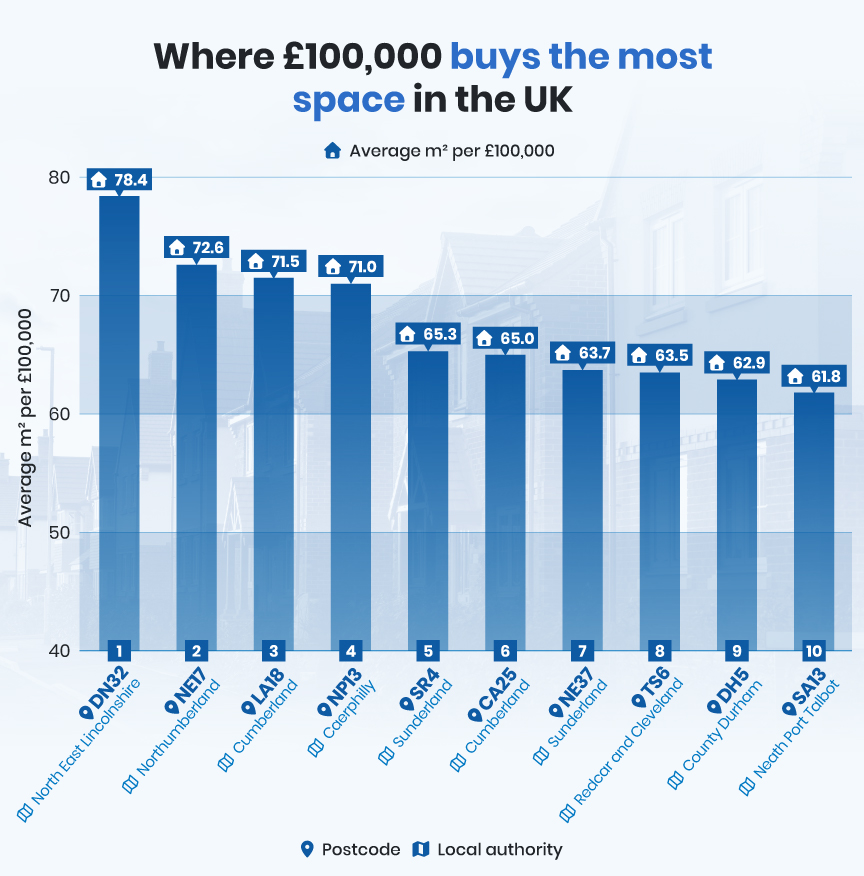
To uncover where buyers get the best value for floor space, we ranked UK postcodes by the average number of square metres available per £100,000 spent, using matched sales data and recorded property sizes.
Across the UK, the average home costs £4,558 per square metre and has a floor area of 99.98 m². This means that, for every £100,000 spent, buyers nationwide get an average of 28.6 m² of space.
The results show a clear regional pattern, with the highest-ranking areas concentrated in northern England and Wales, where lower average house prices allow buyers to secure significantly more space for the same budget.
| Rank | Postcode | Local authority | Average price | Average floor area (m²) | Average price per m² | Average m² per £100,000 |
| 1 | DN32 | North East Lincolnshire | £112,266 | 89.93 | £1,275 | 78.4 |
| 2 | NE17 | Northumberland | £107,178 | 80.61 | £1,377 | 72.6 |
| 3 | LA18 | Cumberland | £136,306 | 97.81 | £1,398 | 71.5 |
| 4 | NP13 | Caerphilly | £117,533 | 86.99 | £1,409 | 71.0 |
| 5 | SR4 | Sunderland | £123,017 | 85.19 | £1,531 | 65.3 |
| 6 | CA25 | Cumberland | £158,386 | 106.77 | £1,539 | 65.0 |
| 7 | NE37 | Sunderland | £125,608 | 81.06 | £1,569 | 63.7 |
| 8 | TS6 | Redcar and Cleveland | £134,641 | 87.10 | £1,575 | 63.5 |
| 9 | DH5 | County Durham | £142,005 | 90.87 | £1,589 | 62.9 |
| 10 | SA13 | Neath Port Talbot | £153,073 | 99.28 | £1,618 | 61.8 |
- DN32 (North East Lincolnshire), 78.4 m2 per £100,000
The DN32 postcode, located in Grimsby, a town in Lincolnshire, offers the highest value for money, with 78.4 m2, which is almost 50 m2 more than the national average.
One reason why it ranks so highly is the affordable average house price in the area, at just over £112,000, which is the third lowest in the country, and almost four times less than the national average.
Grimsby has faced economic challenges during a period marked by the decline of traditional industries, such as fishing, which once played a major role in the town’s economy. In areas where economic growth has been slower, property prices often remain lower, allowing buyers to secure more space for their money.2
- NE17 (Northumberland), 72.6 m2 per £100,000
The NE17 postcode, covering villages such as Chopwell and Blackhall Mill near Newcastle upon Tyne, is one of the best places in Britain for property value, with buyers getting 72.6 m² per £100,000. This is more than double the UK average of 28.6 m².
One reason it ranks so highly is the low average house price in the area, at £107,178, which is the cheapest postcode in the study in which to buy a home.
These villages were historically built around coal mining, and they experienced significant job losses following pit closures. Long-term economic decline has reduced housing demand locally, keeping property prices comparatively low.3
- LA18 (Cumberland), 71.5 m2 per £100,000
The LA18 postcode in West Cumbria, centred on the town of Millom, ranks third for property space per £100,000, with an average of 71.5 m².
You get far more square footage here on average than in the two areas ranking above it, with just under 98 m², perhaps a result of the more rural location. However, the average house price is also higher at £136,000, the 12th most affordable.
Years of economic decline since the closure of the iron ore mines in the 1960s have led working people to leave Millom, but it is hoped that its proximity to the Lake District and industrial hubs like Barrow-in-Furness will turn things around.4
- NP12 (Caerphilly), 71 m2 per £100,000
Caerphilly, specifically NP12 in Blackwood, is the area of Wales where you will get the most space for your money when it comes to buying a home. On average, there is exactly 71.0 m² per £100,000 here.
Homes here sell for an average of £117,533, placing it among the lowest-priced areas in the dataset (4th), while buyers still get close to 87 m² of space.
The area forms part of the South Wales Valleys, where the Welsh Government has identified long-term economic challenges following industrial decline. However, unemployment is about in line with the area’s average, suggesting it is not the primary factor keeping prices down.5
- SR4 (Sunderland), 65.3 m² per £100,000
In Sunderland’s SR4 postcode, buyers get 65.3 m² for every £100,000 spent, placing it comfortably among the top-performing areas, and making it the city where you get the most for your money.
Average prices sit at £123,017, which is significantly below the national average house price, helping stretch budgets further here than in many other urban districts.
Sunderland’s economy was historically built on shipbuilding and heavy industry. Following large-scale industrial decline in the late 20th century, house price growth lagged behind faster-expanding UK cities.6
Where £100,000 buys the least space in the UK
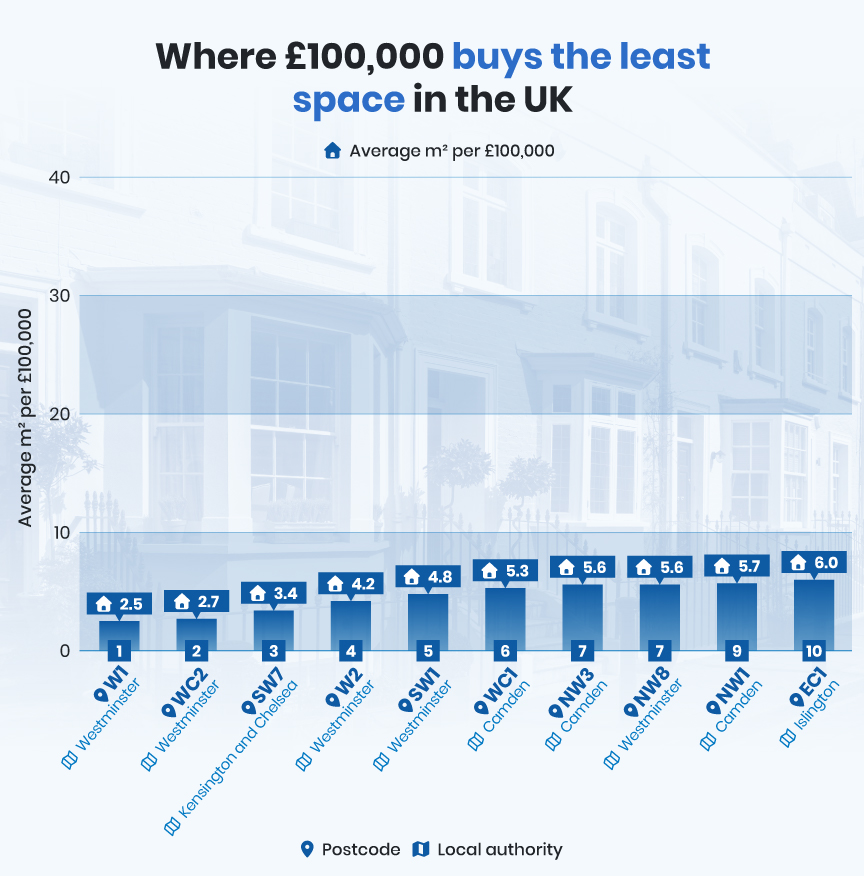
Using the same methodology, calculating average price per square metre and square metres per £100,000, we also identified the postcodes where buyers get the least space for their money.
In stark contrast to the best-value areas, the bottom of the ranking is dominated entirely by prime central London postcodes, where exceptionally high property prices dramatically reduce the amount of space £100,000 can buy, despite often having more floor area.
| Rank | Postcode | Local authority | Average price | Average floor area (m²) | Average price per m² | Average m² per £100,000 |
| 1 | W1 | Westminster | £3,596,759 | 115.06 | £39,619 | 2.5 |
| 2 | WC2 | Westminster | £2,466,682 | 78.91 | £37,045 | 2.7 |
| 3 | SW7 | Kensington and Chelsea | £3,464,490 | 152.70 | £29,177 | 3.4 |
| 4 | W2 | Westminster | £1,655,328 | 95.42 | £23,712 | 4.2 |
| 5 | SW1 | Westminster | £2,570,324 | 157.03 | £20,750 | 4.8 |
| 6 | WC1 | Camden | £1,217,389 | 76.11 | £18,886 | 5.3 |
| 7 | NW3 | Camden | £1,656,047 | 118.61 | £17,964 | 5.6 |
| 8 | NW8 | Westminster | £1,943,345 | 112.18 | £17,845 | 5.6 |
| 9 | NW1 | Camden | £1,349,737 | 86.14 | £17,515 | 5.7 |
| 10 | EC1 | Islington | £1,176,567 | 90.42 | £16,627 | 6.0 |
- W1 (Westminster), 2.5 m2 per £100,000
At the other end of the spectrum is W1 in Westminster, one of the most prestigious postcodes in the country, as it covers central London areas such as Mayfair and Soho. Here you get over 10 times less space for your money than the national average, at just 2.5 m2 per £100,000.
The average house price here is nine times the national average, at over £3.5 million, making it comfortably the most expensive postcode in the study.
The obvious reason for this is the location. The postcode covers some of the most well-known and sought-after neighbourhoods in the world, just a stone’s throw from landmarks such as the Palace of Westminster and luxury shopping streets like Savile Row.
- WC2 (Westminster), 2.7 m2 per £100,000
Another Westminster postcode ranks in second place, as you only get 2.7 m2 per £100,000, meaning you could have around 30 times as much space in Grimsby as you could here.
The average house price here is slightly lower, but it is still £2 million more than the national average. You get much less floor space on average here, at just 78.91 m2, which is well below other postcodes in its vicinity.
WC2 is located in the heart of central London, with landmarks such as the British Museum and the University of London within the postcode, making it a highly desirable location.
- SW7 (Kensington and Chelsea), 3.4 m2 per £100,000
SW7 in the Royal Borough of Kensington and Chelsea has an average of just 3.4 m2 per £100,000, the third lowest in the country.
Although house prices are the second-highest in the country here (over £3.4 million), there is substantially more average floor space, at 152.7 m2, which is 50% higher than the national average.
- W2 (Westminster), 4.2 m2 per £100,000
W2 is a postcode in central London that covers many iconic locations, such as the majority of Hyde Park, Paddington, and Little Venice. The average house here has just 4.2 m2 per £100,000, the fourth smallest in the country.
The average house price in this location is by far the lowest of any postcode in the top five, but it is still amongst the most expensive in the country at £1.66 million.
There is also less space here on average than in the postcodes around it in the rankings, with just 95 m2, which is lower than the UK average of 99.98 m2.
- SW1 (Westminster), 4.8 m2 per £100,000
Probably the most recognisable postcode in the country, SW1 is home to Buckingham Palace, Trafalgar Square, and Big Ben. When you think of London, you likely think of SW1.
Being neighbours with the King does not come cheap; the average house price here is north of £2.5 million. However, you do get a lot of floor space (157.03 m2 on average), resulting in there being 4.8 m2 per £100,000 in SW1.
Property buyers get almost twice the space for their money in the North
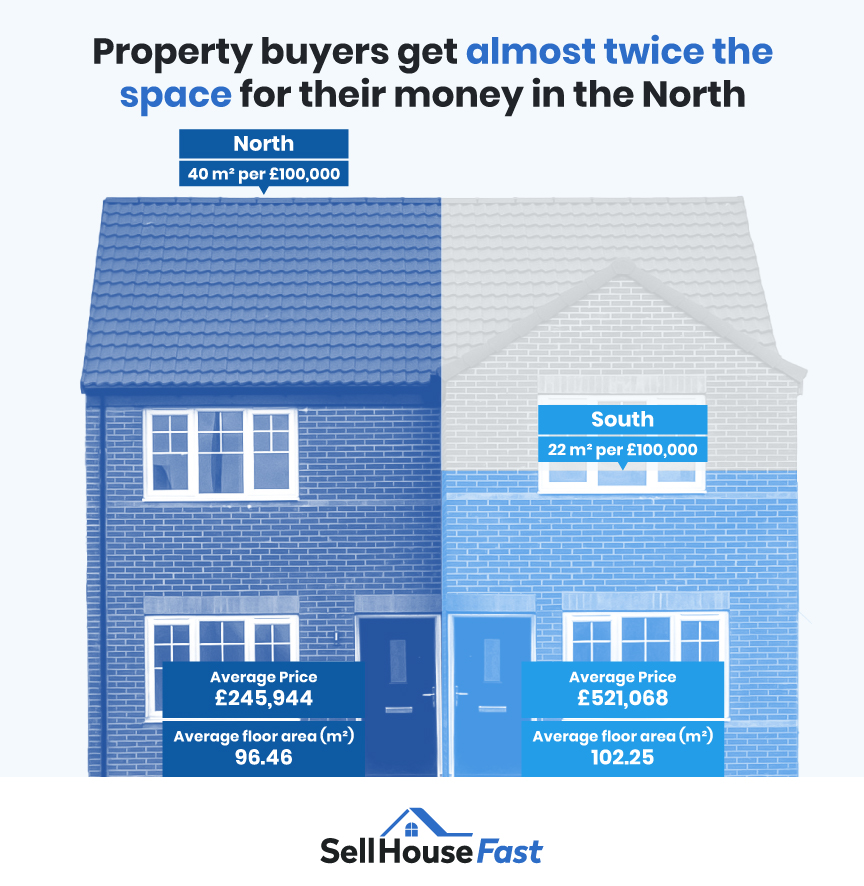
To explore whether these differences reflect a broader regional divide, we calculated the average for all postcodes in the study north and south of the centre point in Leicestershire.
| Rank | Region | Average price | Average floor area (m²) | Average price per m² | Average m² per £100,000 |
| 1 | North | £245,944 | 96.46 | 2,727 | 40 |
| 2 | South | £521,068 | 102.25 | 5,741 | 22 |
In the north of England and Wales, you get significantly more for your money than you do in the South; there is almost double (45.5%) the average square metreage per £100,000 in the North.
Eight of the best-value postcodes, including the top three, are located in northern England or Wales.
The difference is largely driven by property prices rather than home size. Although homes in the South have slightly larger average floor areas, they are far more expensive. On average, a southern property costs around twice as much as one in the North.
While some northern cities such as Manchester have recently seen strong house price growth, southern areas, particularly those close to London, have historically commanded higher prices due to their proximity to the UK’s economic centre.7
What the findings mean for those looking to sell their homes
Jack Malnick, Managing Director and founder of Sell House Fast, comments:
“This report highlights just how dramatically property value can vary across the UK when you look beyond headline prices and focus on price per square metre. “In many northern areas, buyers are able to secure significantly more living space for the same budget, largely because property prices remain much lower than in southern regions or prime London postcodes. At the other end of the spectrum, locations such as Westminster command extremely high prices per square metre due to strong demand, limited supply, and their proximity to major economic and cultural hubs.
“For homeowners, these findings offer useful context when assessing their own property’s value and the type of buyer it may attract. In areas where budgets stretch further, buyers often prioritise space and practicality, while in more expensive markets, location tends to outweigh size. Understanding how your local market compares nationally can help sellers position their property more effectively and set realistic expectations around pricing and demand.
“If you’re aiming to maximise the value of your home, presentation and staging can make a significant difference. Simple improvements such as decluttering, enhancing natural light, and clearly showcasing usable living space can boost perceived value.”
Methodology
Sell House Fast is a leading quick-sale property company that helps homeowners across the UK sell their homes swiftly and securely, without the delays or uncertainty of the open market.
As part of our commitment to helping UK sellers secure quick, stress-free property sales, we have produced this report to provide clear insight into where they can get the most and least space for their money.
Data
- Residential property sales were sourced from the UK Government’s Price Paid Data report.
- EPC records were used to obtain internal floor area measurements.
Notes
- Only sales that could be matched to a valid EPC record containing total internal floor area data were included. Transactions with missing or invalid prices or dates were excluded.
- Only postcode districts with 200 or more matched residential sales were included in the analysis.
- For each matched sale, we calculated the price per square metre (sale price divided by EPC-recorded floor area).
- We then calculated the average price per square metre at the postcode district level.
- The average amount of space available per £100,000 was derived as £100,000 divided by the average price per square metre.
- Postcode districts were ranked by the average amount of internal floor space buyers receive per £100,000 spent.
- To establish the North v South section, we took an average of all postcodes north of Lindley Hall Farm in Leicestershire, which is the centre point of England.