Can I Sell My Flat With Cladding?






The 2017 Grenfell Tower tragedy had a huge impact on the UK property market. What was once a topic centred around insulation and aesthetics took on an entirely different narrative overnight, and both safety and responsibility moved into the spotlight.
For property owners, it opened up a raft of new considerations and, for many, left them feeling trapped in possession of properties they feared (and indeed in many cases still do fear) are unsellable.
The cladding scandal has created a landscape of mortgage refusals, confusing EWS1 certificate forms, and plummeting valuations. However, while the market is definitely more complex than it used to be, it’s not frozen. Thankfully, as of December 2024, the government’s Remediation Acceleration Plan has introduced strict new deadlines for building owners and a clearer exit route for residents.
So, if you’re one of the many who have uttered the words “I can’t sell my flat because of cladding,” read on. Because Sell House Fast can help you here. This guide explores the realities of the current market and how you can achieve a fast flat sale, despite the challenges. Whether you have a high-rise apartment with ACM panels or a smaller block with modern rendering, selling a flat with cladding is still possible.
Can you sell a flat with cladding in the UK?
The short answer is yes, but the long answer depends heavily on the type of cladding, the height of the building, and – vitally – the buyer’s funding source.
Since 2017, the criteria for selling a flat with cladding issues have tightened significantly. In the immediate aftermath of the crisis, the market for affected flats virtually ground to a halt.
Today, the situation is more nuanced. While many traditional mortgage lenders remain cautious, new government schemes and the Building Safety Act 2022 have helped to open doors that were previously bolted shut.
Can you sell a flat with cladding to a traditional buyer? Yes, provided the building has passed its fire safety assessment, or there is a clear, funded plan for remediation. If the building doesn’t have either of these, it’s not the end of the road, but your pool of buyers shifts from first-time buyers to professional cash house buyers and investors.
TLDR: It’s harder to sell a flat with cladding than one without, but successful sales are still happening every single day. It’s just a question of matching your property to the right type of buyer and making sure you have your Leaseholder Deed of Certificate ready to go.
What counts as a cladding issue?
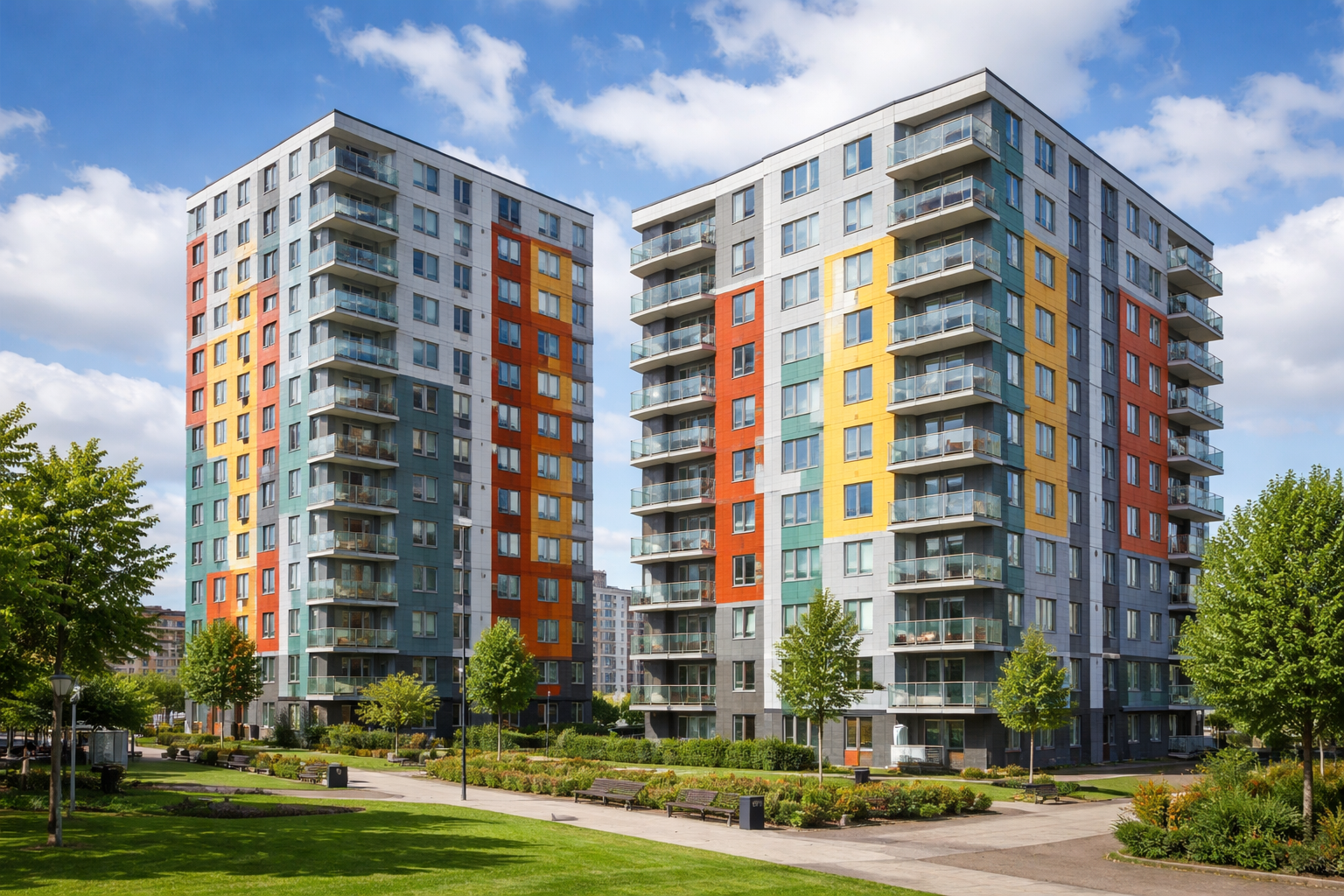
Not all cladding spells complications; it’s more nuanced than that. To navigate a sale, you need to understand exactly what’s attached to your building. Surveyors and lenders can help you with this, and generally categorise materials based on combustibility.
Types of cladding that cause problems
- ACM (Aluminium composite material): The highest risk. Selling a flat with ACM cladding on the open market is extremely difficult without a remediation date in place, as this material was the primary factor in the Grenfell tragedy.
- HPL (high-pressure laminate): Often wood-effect or coloured panels. Many HPL systems have failed fire tests and are treated with similar caution to ACM.
- Timber cladding: While aesthetically pleasing, wood is combustible. Even selling a house with cladding made of timber can be tricky if it covers a significant portion of the exterior.
Unknown materials: In many cases, the issue isn’t that the cladding is dangerous, but that the freeholder can’t prove what exactly it is. Without documentation, lenders (unfortunately) assume the worst-case scenario and tend to steer clear.
EWS1 forms and PAS 9980 explained
The External Wall Survey (EWS1) was introduced to help lenders assess risk. In 2026, these are increasingly supplemented by PAS 9980:2022 fire risk appraisals.
- A1/A2/B1: Generally acceptable for mortgages; the fire risk is low or remediated.
- B2: The fire risk is high enough that remedial works are required. Most lenders will decline a mortgage on a B2-rated building unless a government fund (like the Cladding Safety Scheme) is confirmed to cover the costs.
For a deeper dive into these technicalities, we have an EWS1 certificate guide that goes into more detail.
Why cladding makes flats harder to sell
If you’re selling property with cladding, you’re essentially fighting against three main headwinds: finance, value, and fear.
Mortgage refusals
Most buyers need a mortgage. If a surveyor notes suspect cladding and there’s no EWS1 certificate, or indeed a B2 rating, the lender will often issue what’s known as a ‘zero valuation’. This doesn’t mean the flat is worth nothing, but it does mean the bank won’t lend against it. The bad news? This instantly removes 90% of your potential buyers.
Reduced valuations
Even if a lender is willing to proceed, they might then ‘down-value’ the property. They justify this by factoring in the potential ‘cladding tax’, i.e. the cost of future repairs or the diminished desirability of the building. This makes selling an apartment with cladding significantly more of a challenge for those hoping to achieve peak market rates.
Legal and financial uncertainty
The primary fear for any buyer (not to mention their solicitor) is remediation liability, as in, who pays to fix it? While the Building Safety Act has shifted much of the burden away from leaseholders, the legal process of proving responsibility can take months, which we commonly see cited as the reason a house sale fell through.
Can you sell without an EWS1 form?
This is a common pain point for leaseholders in smaller blocks. Originally, only buildings over 18 metres needed an EWS1. However, some lenders do now demand them for 11-metre-high buildings or, in some cases, even lower.
You can sell a flat with cladding issues without an EWS1, but it does mean your options are limited. Your remaining options are:
- Cash buyers: Because they don’t rely on bank valuations, they can assess the risk themselves and move to completion.
- Low-rise exemptions: Some lenders have recently signed a pact to be more flexible on buildings under 11m, provided they don’t have specific high-risk features.
If you find yourself stuck, seeking a cash house buyer is often the only way to bypass the EWS1 deadlock and sell your flat fast.
Your options for selling a flat with cladding
Option 1: Wait for remediation
Buildings 18m+: Must be remediated by the end of 2029.
Buildings 11m-18m: Must be remediated by the end of 2031.
Pros: You will achieve a normal/standard market price once the works are signed off.
Cons: You may be waiting years.
Option 2: Sell on the open market
Pros: Potential for a higher price if you find a cash-rich investor.
Cons: Extremely high failure rate. Many sales fall through at the eleventh hour when the lender sees the PAS 9980 report.
Option 3: Sell to a specialist cash buyer
Pros: No waiting for EWS1 forms, no mortgage delays, and a guaranteed completion date.
Cons: You will usually accept a discount on the ‘perfect world’ market value, in exchange for the speed and certainty of a fast flat sale.
How much value do you lose on a flat with cladding?
This is the burning question every leaseholder asks, and justifiably so. While every building is different, the so-called ‘cladding discount’ typically follows these trends:
| Cladding status | Estimated value impact |
| Minor issues / Awaiting EWS1 | 5% – 15% reduction |
| B2 Rating (No funding confirmed) | 20% – 40% reduction |
| Severe Risk / ACM (High-rise) | 50%+ reduction |
Note: These figures are based on 2026 market data from the Official Building Safety Data Release, and it should be noted that figures can vary widely.
Can leaseholders be forced to pay for cladding?
One of the biggest breakthroughs for anyone selling a flat with cladding was the Building Safety Act 2022. This landmark legislation created something of a ‘waterfall of responsibility’, as it means that (in most cases) leaseholders are now legally protected from the costs of removing cladding. If the original developer still exists or the freeholder has sufficient assets, they’re the ones who have to foot the bill.
However, the ‘leaseholder cannot sell their flat with cladding’ stigma remains. Even if the remediation is free, the administrative headache and potential for rising service charges of having the work done can easily deter potential buyers. And there remain a clutch of legal grey areas. These include:
The qualifying leaseholder hurdle
To be protected from cladding costs, you have to be a qualifying leaseholder. This generally applies if the building is over 11 metres (or five storeys) high and the flat was your main residence on 14 February 2022.
The Grey Area: If you own more than three properties in the UK, or if your building is what’s known as an ‘orphan building (where the developer has gone bust and the freeholder has no assets), the route to funding becomes significantly more complex. Buyers are often terrified of inheriting a property that doesn’t clearly meet these criteria, as it can lead to a house sale falling through even very late in the legal process.
Non-cladding fire safety defects
The law differentiates between cladding (the external skin of the building) and non-cladding defects (like missing internal fire breaks, faulty fire doors, or wooden balconies, as three examples).
The Grey Area: While cladding removal is often 100% funded, non-cladding fixes are just capped. Which means that, even in 2026, leaseholders can still be charged up to £10,000 (or £15,000 in London) over ten years for these safety issues. For many first-time buyers, a potential £10k bill is enough to make them walk away (and understandably so), which leaves the leaseholder unable to sell their flat with cladding.
The under-11-metre deadlock
The most frustrating grey area remains (because this one’s been around for a while) buildings under 11 metres. These properties don’t qualify for the Building Safety Fund or the Cladding Safety Scheme.
The Grey Area: The government maintains that these buildings are low risk, but many cautious lenders still demand an EWS1 certificate or expensive surveys before they will offer a mortgage. If a surveyor identifies a risk in a 9-metre block, there’s currently no statutory protection at all to stop the freeholder from passing those costs directly to the leaseholders via the service charge.
Why protections don’t always equal a sale
Even when the law says you’re protected, the administrative delay can be a silent deal-killer. It can take six months or more for a freeholder to provide a Landlord’s Certificate, which is required to prove who is paying for the works. If you’re in a rush to move, you might find that you can’t sell your flat due to cladding, simply because the paperwork isn’t moving as fast as your life needs it to.
In these grey areas, traditional buyers rarely have the stomach for the risk. Which is where a professional cash house buyer becomes the only viable option, as they can price in these legal complexities and complete the fast flat sale that the open market just can’t accommodate.
If you find you can’t sell a flat with cladding thanks to these (or any other) legal grey areas, a fast flat sale to a professional buyer might be the best way to move forward.
How to sell a flat with cladding fast: actionable tips
If you need a fast house sale, follow this simple checklist. We’ve been through this process plenty of times before, and we’re more than happy to guide you through it:
- Gather your paperwork: Get the EWS1, the Fire Risk Assessment (FRA), and the Leaseholder Deed of Certificate all in one place and ready to go.
- Be transparent: Don’t try to hide the issue. Whether your issue is tower block cladding or you’re selling a flat that’s part of a smaller building complex, hiding it only leads to the house sale falling through later. It just isn’t worth it.
- Price realistically: If your flat is unmortgageable, it simply cannot be priced in the same way as if you were selling a flat without cladding.
- Target investors: Look for cash house buyers who specialise in ‘defective’ titles (which is what flats with cladding fall under).
Who buys flats with cladding?
- Professional cash house buyers: Like Sell House Fast, who have the liquidity to buy fast, without bank approval.
- Portfolio landlords: Investors looking for long-term yields who are happy to wait out the remediation process.
- Specialist developers: They might buy multiple units in a block to gain control of the management company.
- Lease extension specialists: They know how to navigate the associated risks, so aren’t necessarily put off by cladding issues.
Sellling a flat with cladding issues made easy
Living in a flat with cladding can feel like being stuck in financial limbo. Whether you find that you can’t sell flat because of cladding on the open market, or you’re simply tired of the delays, which can be lengthy, the important thing to remember is that you’re not trapped. Sales of houses and/or flats with cladding do still happen all the time.
Furthermore, selling a flat with cladding isn’t only possible, but doesn’t have to be a multi-year ordeal. By choosing the right route, you can secure your future and move on to your next home. Multiple routes are available to you, and the path you choose depends entirely on the speed at which you need to move forward.
At Sell House Fast, we buy properties in any condition across England and Wales in as little as 7 days. Whether you want to sell below market value or get a fair cash offer for your home, we’re here to help.
Contact us today for a free, no-obligation quote and see how we can help you achieve a fast house sale, regardless of any cladding issues.